
Notebook
and Stories
Blog
The Blue Windows, Hilary Nicoll
Artwork, Curation, Exhibition, Language, Making, Museum, WritingPosted on December 10, 2025
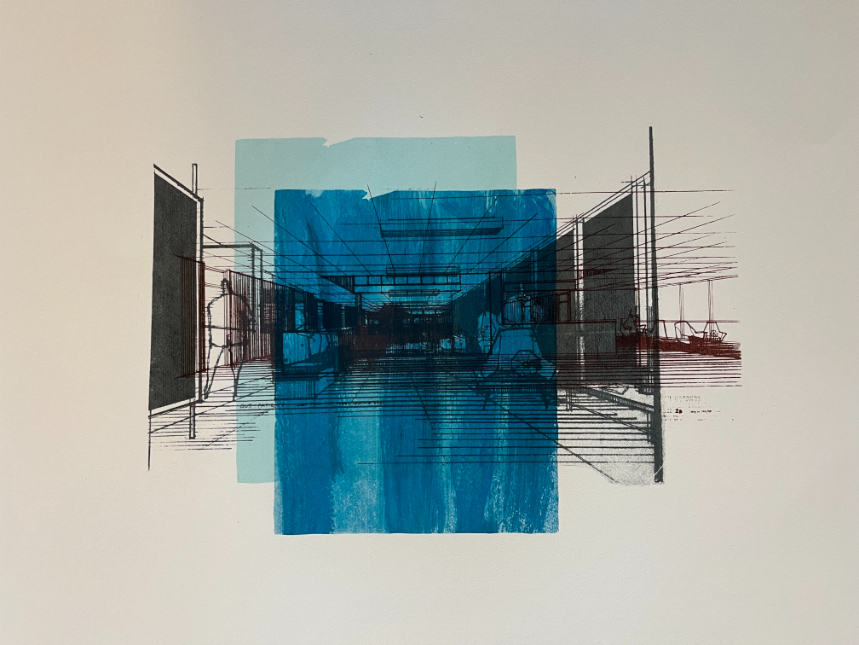
Silkscreen on Fabriano paper, Variable edition of 12, 50 x 70 cms
As my year as Associate with Tracy Mackenna Studio / The Museum of Loss and Renewal comes to an end, I am really delighted to share some new work that has come about through the focussed and supportive environment that the role has provided.
This is an edited except from a longer work-in-progress, in which my research into family artifacts and ephemera, found as my father was lost to Alzheimer’s, has developed into an imaginary museum, the objects and their stories standing in for memory as it disappeared. It sits alongside my print, The Blue Windows, adding context to my visual arts practice.
The Blue Windows, Hilary Nicoll, 2025
It’s a bright February morning when I step off the train at Puurs, a town near Antwerp that I had never heard of until a few weeks ago. I am in a warm coat and boots against the chill of the Flemish Spring and immediately I can see the man I have arranged to meet here. He has recognised me by the red scarf I told him I’d be wearing, and is striding towards me, smiling.
A message had arrived from my sister well over a year ago, with a scan of a letter she thought I would be interested in. It had been sent from Belgium by my grandfather during the Second World War, to his eldest son David, then a boy of nine. It described arriving at a ‘real’ fort with a moat, drawbridge and a tunnel. ‘I parked my little armoured car and was introduced to the free Belgians. Do you know that a party of them captured this with their bare hands, and now they have several hundreds of prisoners somewhere beneath me, including some Gestapo … I have been invited to see the unfortunates tomorrow’.
As I read the word ‘tunnel’ an image formed in my mind, small, grainy and black-and-white. It is a photograph of a tunnel, set into a page of text in a novel I had read some years back. W G Sebald’s ‘Austerlitz’ is a haunting book in which, through a series of uncanny encounters with places and things, vanished memories reappear.
Sebald’s photograph was taken at a fort in Belgium called Breendonck. I became so convinced that the place in the book and the place in my grandfather’s letter were one and the same that I chased it down, finding, after some drawn-out and haphazard research, that my hunch was at least partially correct. Now I had come to see it for myself.
The letter, from October 1944, was one of the last my grandfather would write before he was killed in action. He left my grandmother with five children under the age of ten, one not born until three days after his death. All my father remembered of him was once blowing foam from the head of his glass of beer. Dad had his own letters, eighteen of them, the first sent for his first birthday in March 1941. It is a translucent rectangle of pale blue, a small window through which to catch a fleeting glimpse of his ‘distant but very loving dad’.
The man striding towards me is Kurt, the co-ordinator of the museum I am here to visit. He greets me warmly and ushers me to his car. I made contact with him after months of research to find where the letter had been written, convinced all along it was the place in Sebald’s book. Eventually I was pointed in the direction, not of Breendonck, but of a Fort called Liezele, now a military history museum. My disappointment at this news was such that I gave up the search for a while, feeling stupid that I had allowed myself to be so convinced by nothing more than a hunch.
But the business felt unfinished, and in the summer of 2023, I sent an email to Fort Liezele. It was Kurt who replied. He wrote that, yes, my grandfather’s regiment had been stationed there in 1944. The museum had only recently found this out. He recognised the description of the moat, the drawbridge and the tunnel. They are still the same today. But my grandfather’s letter didn’t all make sense. Liezele was never liberated by the Belgians and prisoners would not have been held there. There is a fort only 10 minutes away, his email continued, called Breendonck. It had been a camp run by the SS for political and Jewish prisoners and was turned into a prison again after the liberation, this time by the Belgian resistance who used it to hold Nazi collaborators. Breendonck, with this infamous reputation was a place that my grandfather had probably been told about and decided to visit.
My grandfather, for reasons I will never know, was telling two stories at once, and to do so had merged both forts into a single place. Perhaps it was an economy of time or paper size, or, more likely I think, to add boys-own drama for his nine-year-old reader. Whatever is going on between the facts and his fiction, the astonishing thing is my intuition had been proved, at least in part, correct.
Arriving at Liezele I could see ahead the drawbridge described in my grandfather’s letter, and the entrance to the tunnel, the same one he drove through all those years ago. We tour the museum, then, after lunch drive the short distance to Breendonck, a place that, even though it is an exact architectural twin of Liezele, is a very different prospect.
It is now a national monument and is bustling with school children, crocodiling dourly through the tunnels and exhibits. Sebald wrote that perhaps he did not really want to see what was there, and there is a sense that these young people feel the same way. Breendonck had housed an inhumane regime of hard labour and torture, and it is as though this horror still lingers in the seeping concrete walls.
In the prisoners’ quarters, lined with rows of concentration camp bunks, I see that the windowpanes are a curious deep blue, covered all over in paint brushed on with hurried strokes that is entirely opaque in places, while in others the outside light just breaks through, stained-glass radiant. I take some photographs.
‘Why is there paint on these windows?’ I ask Kurt.
‘So the prisoners can’t see out’, he replies.
And with that, the moment of strange beauty amid the squalid surroundings is upended. This colour that has always drawn me to it becomes now an instrument of torture, blocking everything that lies beyond the intolerable here-and-now. The paint is there not only to obstruct what the eye can see, but where the mind can wander. Blue is the colour of distance. It is Rebecca Solnit’s ‘colour of there seen from here’. Linked to longing, a literal stretching beyond, here the colour of the far away obliterates that very thing. ‘Even though we are blue’, the windows say, ‘there will be no ‘there’ from here’.
Weeks after the trip is over, the beauty-and-horror of daubed Prussian blue thinning to deep marine and almost-turquoise on those windows still haunts me. And always in attendance is the word ‘obliteration’, as I try to describe the dreadful purpose of the colours, to myself, or anyone that might listen. On a whim, I decide to find its etymology.
‘Obliterate’ is derived from the Latin ‘litteras’. A written document. A letter.
To ‘obliterate’ means to destroy a letter.
I think about the two letters from my grandfather. One robin’s-egg fragile for my father’s first birthday, the other a small work of fact and fiction. They collide with the obfuscating blue windows, ephemeral survivors that have made their presence felt to wrestle back transparency from opaqueness, the far away from the here-and-now, memory from forgetting.
There is to be a new gallery at Museum Fort Liezele. Part of it will display my grandfather’s story. There is a large portrait of him in uniform, and a copy of the letter to his eldest son. A framed map shows the location of his death and in a brightly-lit case there are items of kit and military attire from his regiment, that the museum team spent months sourcing, ensuring they were correct. There is even a photograph of his grave, taken by Kurt and his colleague Tim, who drove to Germany to visit the vast cemetery where he lies buried among seven and a half thousand others, marked by white gravestones laid out, row upon vast row, in immaculate grounds among serene woodlands. I have been sent a photo from this trip, showing one of these men standing behind the pristine headstone, paying his respects.